Most websites do not struggle with SEO because they lack effort.
They struggle because effort is misplaced.
In our experience at Digital Mentor Academy, we have seen brands pour money into backlinks while their pages barely explain what they offer. We have also seen beautifully written websites that never rank because no one outside the site acknowledges their existence.
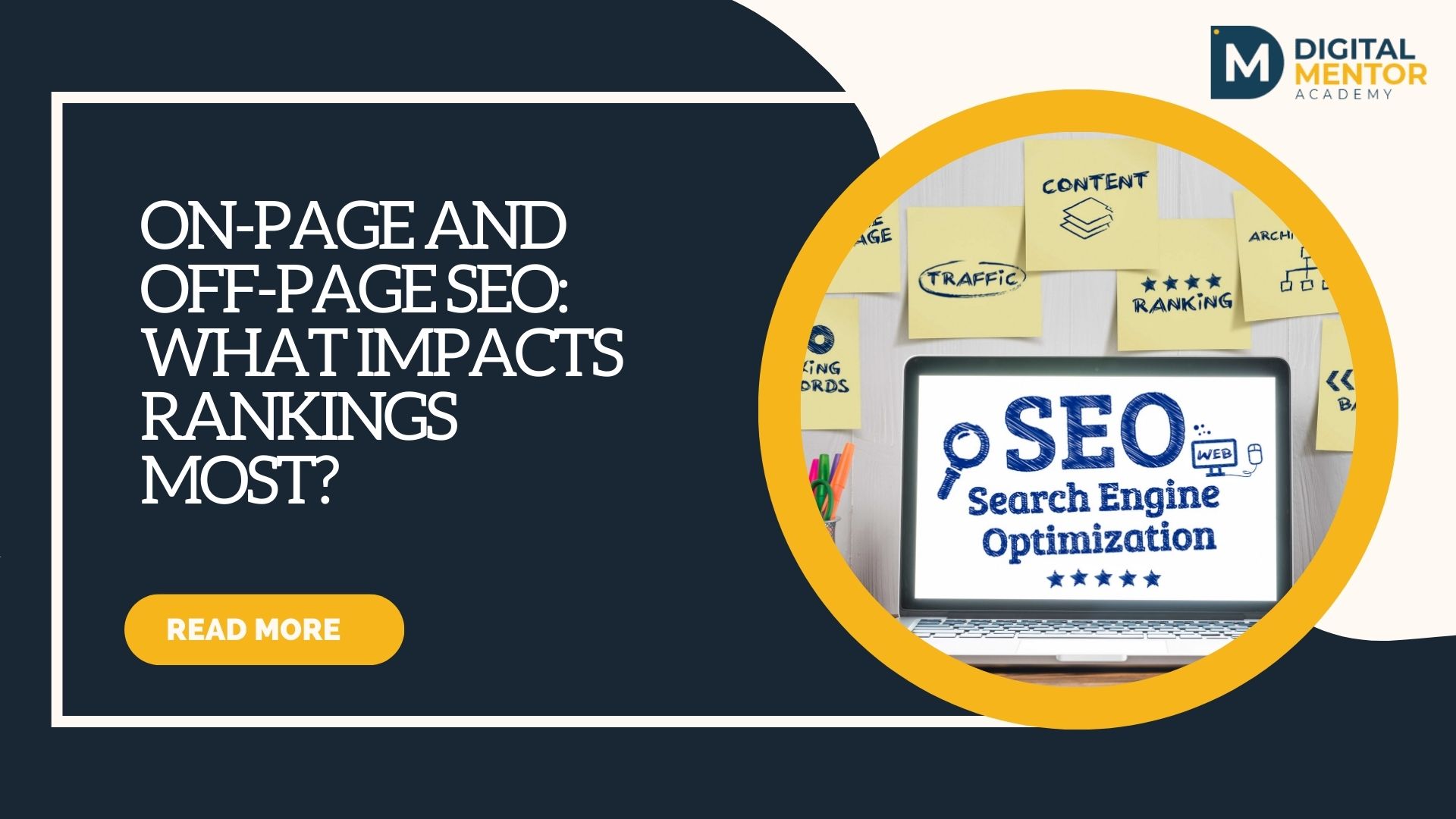
This is why the debate around on-page SEO vs off-page SEO keeps coming up. Not because people do not know the definitions, but because they want to know where rankings truly come from and where their time and budget should go first.
The answer is not balanced as blogs usually claim. It is sequential, strategic, and heavily dependent on the competitiveness of your space.
Let’s talk about what really matters and why.
On-Page SEO Is Not About “Optimisation.” It Is About Clarity.
Most explanations of on-page SEO stop at lists. Keywords, meta tags, headings, internal links. That is surface-level knowledge.
What on-page SEO actually does is help Google understand three things:
- What your page is about
- Who it is for
- Whether it deserves to rank for a specific intent
If any one of those is unclear, the rankings plateau.
Why On-Page SEO Decides Your SEO Ceiling
In our experience, no page ranks consistently if it fails at one of these levels:
Intent alignment
We have seen pages targeting “on-page SEO” that read like beginner glossaries, even though the search intent clearly expects practical guidance. Those pages never cross page two, no matter how many links they get.
Information depth
Google rewards pages that finish the user’s thinking. Thin content forces users back to search results, which is a strong negative signal.
Structural clarity
Clean headings, logical flow, and internal linking tell Google what matters most on the page. Pages without this structure tend to rank temporarily and then slide.
At Digital Mentor Academy, we treat on-page SEO as the discipline of removing ambiguity. When Google doesn’t have to guess, rankings become more predictable.
Off-Page SEO Is About Trust, Not Popularity
Off-page SEO is often reduced to backlinks, but that simplification causes more harm than good.
Google does not reward links.
Google rewards credible validation.
Why Off-Page SEO Becomes the Deciding Factor Later
Once multiple pages do a good job with on-page SEO, Google looks outward.
We have seen this repeatedly in competitive niches:
- Two pages with similar content quality
- Similar technical setup
- Similar user engagement
The page with stronger off-page SEO wins almost every time.
Why?
Because off-page SEO answers a different question:
Do others trust this source enough to reference it?
That trust comes from:
- Editorial backlinks from relevant sites
- Brand mentions in the right contexts
- Industry recognition over time
At Digital Mentor Academy, we have seen off-page SEO fail when brands chase volume instead of relevance. Ten low-quality links often dilute trust rather than build it.
The Real Hierarchy: Which One Matters First?
Instead of asking which matters more, the smarter framework is to focus on dependencies.
On-Page SEO Comes First Because Everything Else Depends on It
You can build links to a weak page, but you cannot force Google to trust it.
In real-world audits we have done, poor on-page SEO usually shows up as:
- Rankings that spike and drop
- Traffic that does not convert
- Pages ranking for irrelevant queries
Fixing on-page SEO almost always stabilises performance before any link-building begins.
Off-Page SEO Multiplies What Already Works
Once a page:
- Matches search intent
- Holds user attention
- Answers questions clearly
- Off-page SEO accelerates growth.
This is where many SEO strategies fail. They try to multiply zero.
Where Most Websites Get This Wrong
1. Investing in Backlinks Too Early
We have seen brands spend months on off-page SEO only to realise their content never deserved to rank in the first place.
2. Treating Keywords as Checkboxes
On-page SEO fails when keywords are inserted without understanding why someone searched them.
3. Ignoring Internal SEO Signals
Pages that do not receive internal links are often considered low-priority, regardless of external backlinks.
4. Copying Competitors Blindly
What worked for an established domain may not work for a newer one. SEO is relative, not absolute.
When NOT to Focus on Off-Page SEO
This is something AI-written content almost never tells you.
Do not prioritise off-page SEO when:
- Your bounce rate is high
- Users do not scroll or engage
- Pages rank briefly and then disappear
- You are unclear about search intent
In these cases, backlinks mask problems rather than fix them.
At Digital Mentor Academy, we always diagnose on-page performance first. It saves time, money, and frustration.
A Practical Framework We Use at Digital Mentor Academy
Here is a simplified decision model we use internally:
Step 1: On-Page Readiness
Is the content better than what already ranks?
Does it fully answer the query?
Is the structure clear to both users and search engines?
Step 2: Engagement Signals
Are users staying?
Are they scrolling?
Are they clicking internal links?
Step 3: Authority Signals
Only now do backlinks and brand mentions become the priority.
This framework consistently outperforms random optimisation efforts.
Final Insight: Rankings Are Earned in Layers
On-page SEO earns relevance.
Off-page SEO earns trust.
Google does not choose between them. It expects both to be applied in the right order.
If you are early-stage or struggling to rank, on-page SEO will give you the fastest clarity and control.If you are competing in a crowded space, off-page SEO will be the differentiator.
The strongest SEO strategies are not loud. They are deliberate.
And that is exactly how Digital Mentor Academy approaches on-page SEO and off-page SEO: not as tactics, but as systems designed for long-term rankings, not temporary wins.