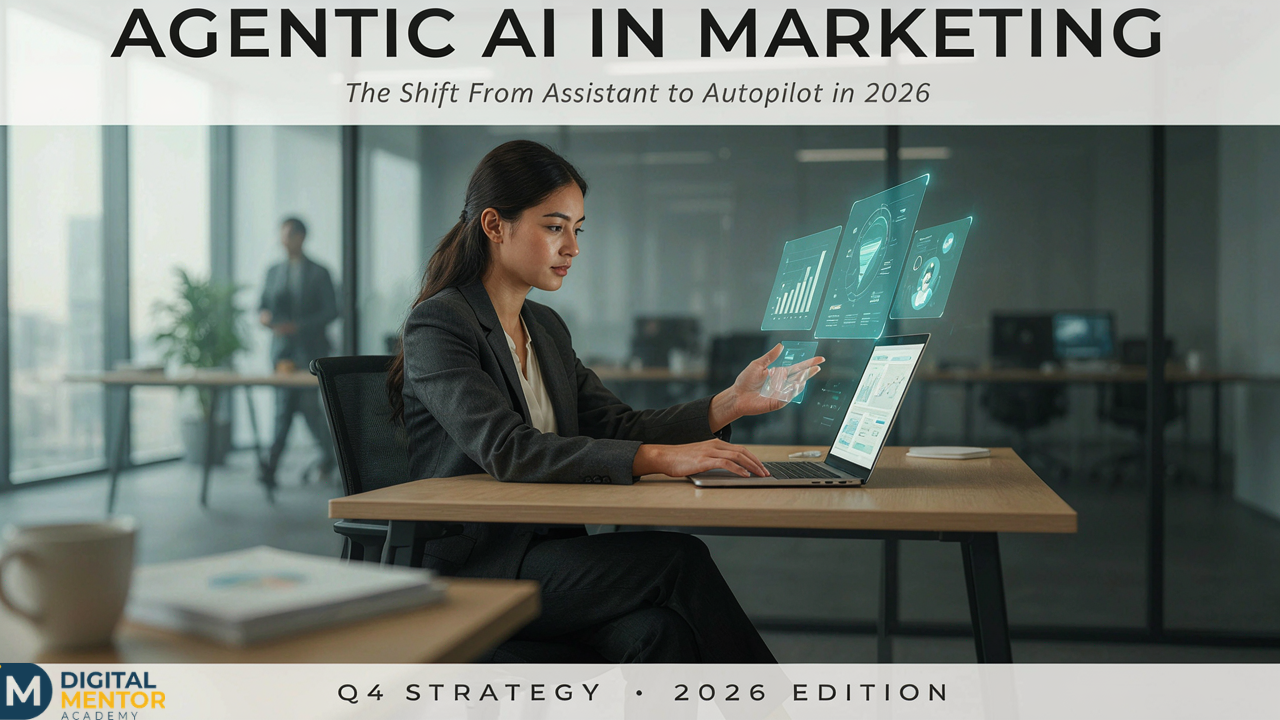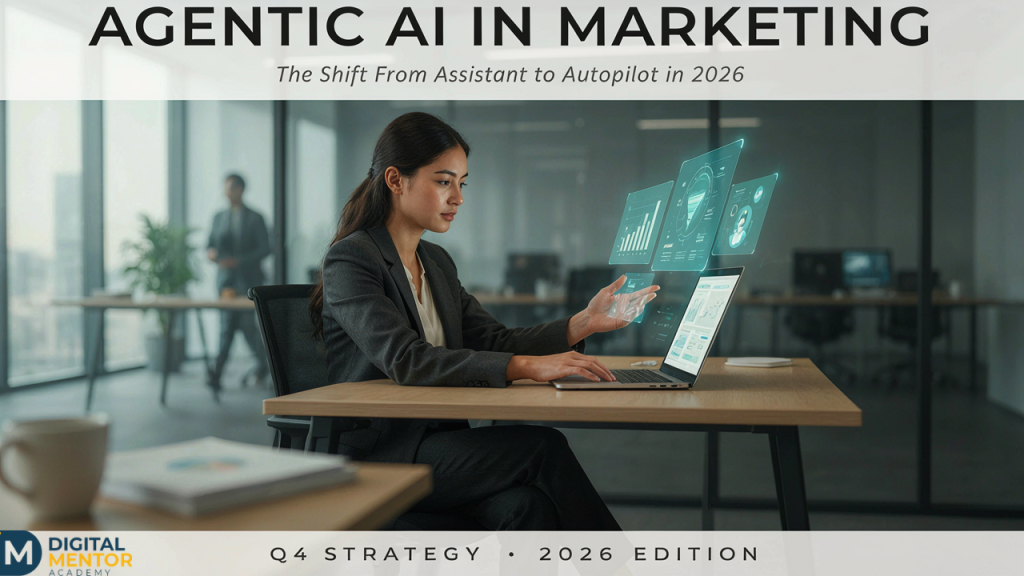
Last year, a marketer’s AI tool waited for instructions. This year, it’s starting to make decisions on its own, adjusting a bid, pausing an underperforming ad, drafting and sending a follow-up email, all without anyone typing a single prompt in between. That shift, from a tool that responds to one that acts, is what people mean when they talk about agentic AI in marketing, and most marketers haven’t fully clocked how big a change it actually is.
For years, AI in marketing meant assistance. You asked, it answered. You prompted, it generated. The human stayed firmly in the driver’s seat, reviewing and approving every output. Agentic AI breaks that pattern. It doesn’t just respond to instructions; it pursues a goal, makes a sequence of decisions to get there, and only checks back in with a human when something genuinely needs judgment. That’s the difference between a calculator and an autopilot.
What Makes AI “Agentic” in the First Place
Here’s where things get interesting. Traditional marketing AI tools, the ones most people are already familiar with, are reactive. You give ChatGPT a prompt, it writes copy. You give a design tool a brief, it generates a graphic. Nothing happens until you ask.
Agentic AI in marketing works differently because it’s built around goals, not single instructions. Give it an objective, say, “improve this campaign’s cost per lead,” and it can independently analyse performance data, test different audience segments, reallocate budget across channels, and report back on what worked. It chains multiple actions together toward an outcome instead of waiting for a new prompt after every step.
Google’s advertising platforms are already moving in this direction with automated bidding and campaign optimisation that adjusts in real time. Meta’s Advantage+ campaigns work on a similar principle. What most people don’t realise is that these aren’t experimental features anymore; they’re becoming the default way campaigns run.
Where Agentic AI Is Already Changing Marketing Work
Campaign Management on Autopilot
Instead of a marketer manually checking ad performance every morning and adjusting bids by hand, agentic systems now monitor performance continuously and make micro adjustments throughout the day. The marketer’s role shifts from executor to supervisor: set the strategy and guardrails, then review outcomes rather than manually operating every lever.
Personalised Customer Journeys at Scale
In our experience watching this space evolve, one of the most practical applications is in customer journey orchestration. An agentic system can track a lead’s behaviour across email, website, and ads, then autonomously decide the next best action for that specific person: a follow-up email, a retargeting ad, a discount offer, without a marketer manually building that logic for every single segment.
Content Operations and Workflow Automation
Agentic AI in marketing is also reshaping content pipelines. Instead of a human briefing every asset individually, an agent can take a content calendar, generate drafts, route them for approval, make revisions based on feedback, and schedule publishing, essentially running the operational backbone of content marketing with minimal manual handling.
Why This Isn’t the Same as “AI Taking Over”
This is the part that causes the most confusion, so let’s be precise. Agentic AI executing a sequence of tasks is not the same as agentic AI setting strategy. These systems follow goals, not set them. Someone still has to decide what “success” means for a campaign, what the brand’s risk tolerance is, and what outcomes actually matter to the business. An autopilot still needs a pilot who decided the destination.
What most companies are discovering, sometimes the hard way, is that agentic systems left unsupervised can optimise for the wrong thing entirely. An agent chasing “maximum clicks” without proper guardrails might burn budget on low-quality traffic. The marketer’s job hasn’t disappeared; it has moved further up the decision chain.
The New Skill Set Every Marketer Needs
Designing Goals and Guardrails, Not Just Prompts
Working with agentic systems means defining clear objectives and boundaries upfront: what the AI can decide on its own, and what needs human sign-off. This is a strategic skill, closer to management than to copywriting.
Reading Outcomes, Not Just Outputs
When an agent runs a campaign autonomously for a week, the marketer’s real value is in interpreting what happened and why, then adjusting the strategy for the next cycle. That requires solid analytical thinking, not just comfort with dashboards.
Cross Platform Fluency
Agentic AI in marketing rarely operates in a single tool. It often coordinates across ad platforms, CRMs, and email systems at the same time. Understanding how these platforms connect, and where a mistake could cascade across all of them, matters more than ever.
What This Means for Marketers Entering the Field in 2026
If you’re starting a career in marketing right now, this shift actually works in your favour, provided your training reflects it. Marketers who learned digital marketing purely as manual execution, writing every ad by hand, building every audience segment from scratch, will find themselves managing systems they don’t fully understand. Marketers who learn to direct these systems, set their goals, interpret their results, and step in when judgment is needed will be the ones businesses actively seek out.
How Digital Mentor Academy Keeps You Ahead of This Curve
That’s why our post-graduate digital marketing program is built around practical, hands-on application of current AI tools rather than outdated theory. Students work on live business case studies where they learn not just how to run a campaign, but how to supervise and direct the automated systems increasingly running campaigns behind the scenes. With small batch sizes, experienced faculty, and 100% placement assistance, the goal is to make sure you’re the person setting the strategy for agentic AI in marketing, not the person left behind by it.
The shift from assistant to autopilot is already underway. Marketers who understand how to steer it, rather than compete with it, will define the next few years of this industry. If you want to be one of them, the right training makes all the difference.