You spent months perfecting your SEO strategy, keyword research, backlinks, meta tags, the whole playbook. Your pages were ranking. Traffic was coming in.
Then something shifted.
People stopped scrolling through ten blue links. They started asking ChatGPT, Google’s AI Overviews, and Perplexity for answers, and getting them instantly, without ever clicking through to your website. The traffic dipped. The impressions stayed, but conversions didn’t follow.
This is not a glitch. It’s a structural shift in how people find information online. And it has a name: Generative Engine Optimisation, or GEO.
If you’re a marketer, a student preparing for a career in digital marketing, or a business owner trying to stay visible online, understanding GEO is no longer optional. It’s the difference between being found and being invisible.
What Exactly is Generative Engine Optimisation (GEO)?
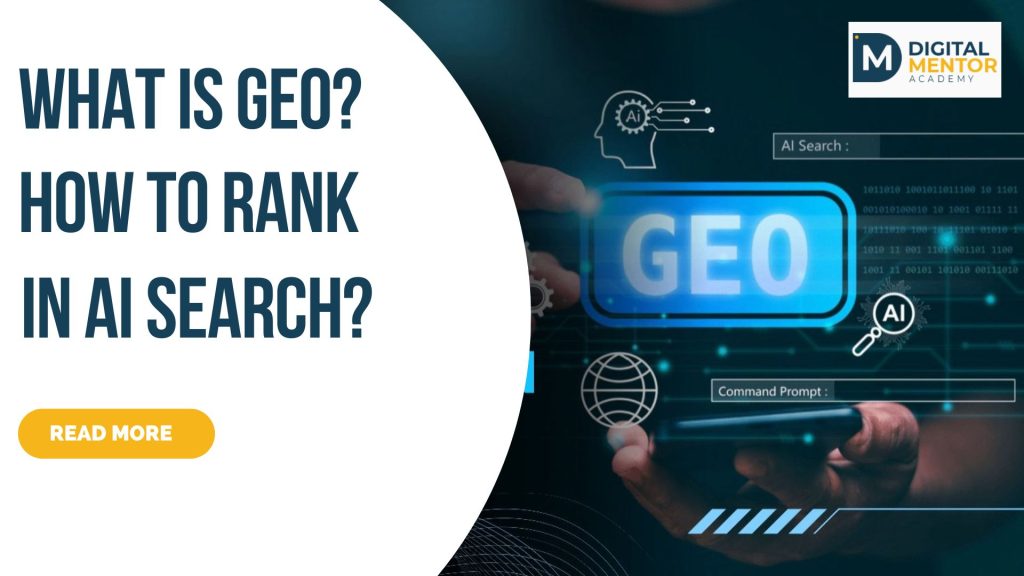
Generative Engine Optimisation is the practice of structuring and writing your content so that AI-powered search engines, like Google’s Search Generative Experience (SGE), ChatGPT, Perplexity, and Bing Copilot, understand, trust, and cite your content in their AI-generated responses.
Traditional SEO got you to the top of the search results page. GEO gets you into the AI’s answer itself.
Here’s what most people don’t realise: generative AI doesn’t rank pages the way Google used to. It synthesises content from multiple sources and presents a single, confident answer. If your content isn’t structured in a way these engines can interpret and quote, you won’t appear in that answer, no matter how good your SEO fundamentals are.
GEO is still emerging as a discipline, but early research and practitioner experience are already pointing to a clear set of signals that matter.
Why Traditional SEO Is No Longer Enough
Let’s be direct about this: traditional SEO isn’t dead, but it’s no longer the full picture.
A few years ago, ranking on page one of Google was the goal. Today, a large and growing percentage of searches return an AI-generated summary at the very top of the page. Users read that summary, get their answer, and move on. Your page might be the fourth result and still get zero clicks.
This phenomenon is being referred to as zero-click search at scale. And it’s accelerating as people naturally begin to use AI in digital marketing workflows and research habits.
The implication? You need to play by two sets of rules now, one for traditional search algorithms and one for generative AI engines. GEO is that second set of rules.
How Generative AI Engines Actually Work
Before you can optimise for something, you need to understand how it thinks.
Generative AI engines like ChatGPT and Google’s SGE are trained on massive text datasets. When someone asks a question, the model doesn’t “search” the web the way Google does; it generates a response using its training and, in newer models, real-time retrieval from trusted sources.
What makes a source trusted in this context? A few things:
- Authority and credibility: Is the content written by someone with demonstrable expertise?
- Citation worthiness, Is the content specific, factual, and well-structured enough to quote?
- Freshness: Is it regularly updated and relevant to current queries?
- Entity clarity: Does the AI clearly understand who you are, what you do, and what you’re known for?
This last point is more important than most marketers realise. Generative AI works on the concept of entities, people, organisations, topics, and the relationships between them. If your brand, your authors, or your content aren’t clearly identifiable as entities in the AI’s understanding, your chances of being cited drop significantly.

Key GEO Strategies That Actually Work
1. Write in the Way AI Engines Quote
AI models love content that is precise, structured, and answers questions directly. Think about how a Wikipedia entry is written: clear definitions, factual statements, and clean formatting. That’s the style of GEO rewards.
Practically, this means:
- Open sections with a direct answer to the likely question, then elaborate
- Use definition-style language for key concepts (e.g., “Generative Engine Optimisation is…”)
- Avoid vague, opinion-heavy, or meandering introductions
- Break content into clearly labelled H2 and H3 sections
2. Build Topical Authority, Not Just Keyword Coverage
GEO rewards depth over breadth. An AI engine is more likely to cite a website that has covered a topic comprehensively across multiple related pieces of content than one that has a single well-optimised page.
If you’re in digital marketing, this means building content clusters, a pillar page on, say, digital marketing careers, supported by detailed articles on SEO, social media, PPC, content strategy, email marketing, and now GEO. Each piece reinforces your authority on the broader topic.
3. Optimise for Entity Recognition
This is where things get interesting from a technical standpoint. To be recognised as a trustworthy entity by AI search engines, you need consistent information across the web:
- Your brand name, location, services, and credentials should match across your website, Google Business Profile, social platforms, and third-party directories
- Use structured data markup (Schema.org) to explicitly tell search engines who you are and what your content is about
- Get cited or mentioned on credible external sites, not for backlink juice, but for entity association
4. Use ChatGPT for Marketing, But Understand Its Limits
There’s a useful distinction to draw here: using ChatGPT for marketing execution (drafting content, brainstorming campaigns, writing ad copy) is very different from optimising for it as a search channel.
Both matter. As a practitioner, leveraging AI tools to scale your content production and strategy is now a baseline skill. But producing AI-assisted content without a clear GEO strategy means you’re feeding the machine without appearing in its outputs. The smartest marketers are doing both.
5. Prioritise E-E-A-T Signals More Than Ever
Google’s E-E-A-T framework (Experience, Expertise, Authoritativeness, Trustworthiness) was designed for traditional search, but it maps almost perfectly onto what generative AI engines look for when deciding whether to cite a source.
Practical ways to strengthen E-E-A-T:
- Add detailed author bios with credentials and professional experience
- Back claims with data, research, and source citations
- Include first-person experience where relevant (“In our experience training students…”)
- Keep content updated; a stale blog from 2021 is unlikely to appear in an AI answer about trends in 2025

GEO in the Context of a Digital Marketing Career
Here’s something worth pausing on if you’re considering building a career in digital marketing, or if you’re already in one and wondering where things are headed.
The job description of a digital marketer has shifted meaningfully. Three years ago, knowing SEO, social media, and paid ads was enough to get your foot in the door. Today, hiring managers at agencies and in-house teams are increasingly looking for professionals who understand AI in digital marketing, not just as a tool to use, but as a channel to strategise for.
GEO is one such skill. So is prompt engineering, AI-assisted content strategy, and understanding how models like GPT-4 and Gemini process and surface information.
What this means in practice: the digital marketing course in Mumbai or Thane you’re considering should have this conversation built into its curriculum. Not as a bonus module, but as a core part of how modern digital marketing is taught. The gap between institutions teaching yesterday’s syllabus and those aligned with where the industry is going is becoming very visible and very consequential for students.
What GEO Is Not
A quick clarification, because there’s confusion creeping into the conversation:
GEO is not about gaming AI systems with tricks or prompt-like language in your content. It is not a separate discipline from SEO; it builds on it. And it is not something that makes your existing content strategy irrelevant.
Think of it as an evolution. Strong, authoritative, well-structured content has always been the goal. GEO sharpens the brief and adds new technical and semantic layers on top.
The Honest Reality
Generative Engine Optimisation is still developing. Best practices are being tested, debated, and refined in real time. But the direction is clear: AI search is not going away, and the businesses and professionals who understand how to create content that AI engines trust and cite will hold a significant advantage.
If you’re just starting to explore this, the best move is to build a strong foundation first: understand SEO deeply, learn how AI tools work in marketing contexts, and develop the habit of creating content that genuinely answers questions with precision and authority. Everything else follows from that.
At Digital Mentor Academy, these are exactly the kinds of skills built into how digital marketing is taught, not just the theory, but the real, evolving, agency-relevant practice. Because understanding concepts like GEO isn’t advanced knowledge anymore. It’s becoming the baseline.