A website ranked #1 on Google for two years. Consistent traffic, solid leads, good business. Then Google AI Overviews rolled out more widely, and that same website saw its organic clicks drop by nearly 40% without losing a single ranking position.
The page was still number one. Google just stopped sending people to it.
This is the new reality of SEO in 2026, and it’s catching many marketers and businesses off guard. If you’ve noticed a dip in organic traffic this year despite holding your rankings, Google AI Overviews is almost certainly part of the reason. More importantly, understanding how to respond to this shift, rather than panic over it, is what separates marketers who thrive from those who scramble.
What Are Google AI Overviews, Exactly?
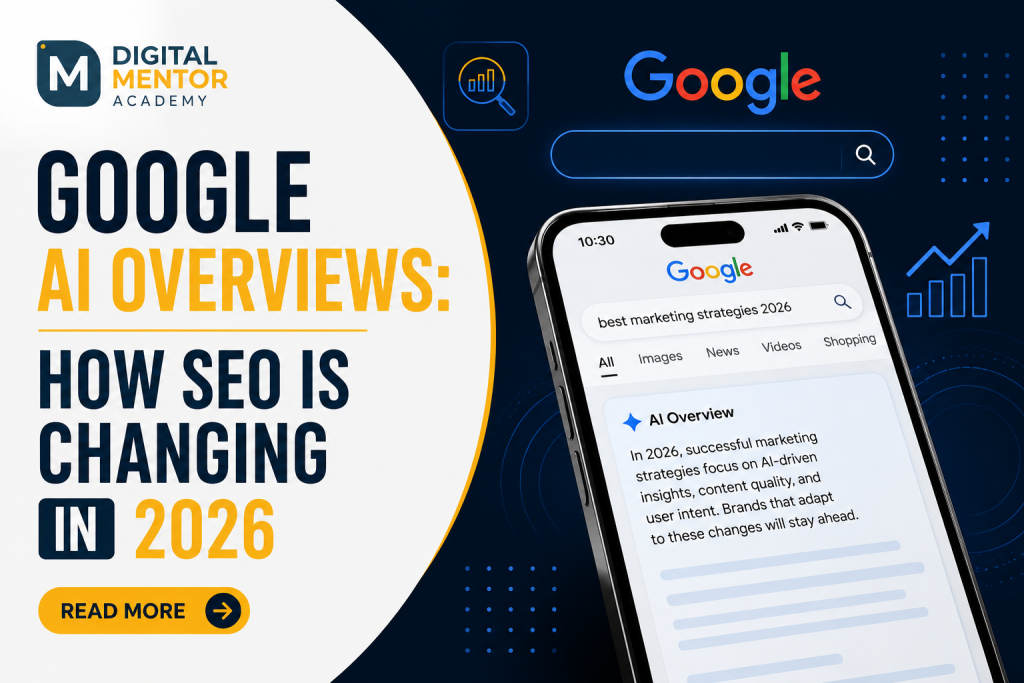
Google AI Overviews (previously called Search Generative Experience, or SGE) are AI-generated summary boxes that appear at the very top of search results, above the traditional blue links, featured snippets, and everything else.
When a user types a question into Google, instead of seeing a list of websites to click through, they now often see a direct, synthesised answer generated by Google’s AI. Sources are cited at the side, but the answer itself is already there on the page.
For users, it’s genuinely convenient. For websites that relied on informational search traffic, it’s a significant disruption.
What makes Google AI Overviews different from featured snippets is the scope. Snippets pull one block of text from a single source. AI Overviews synthesise information from multiple sources, rewrite it in conversational language, and present it as a complete answer, all without the user needing to visit a single website.
How Google AI Overviews Are Reshaping SEO in 2026
The “Zero-Click” Problem Just Got Bigger
Zero-click searches, queries where users get their answer on the results page without clicking anything, have been growing for years. AI Overviews have accelerated this dramatically.
Research across the SEO industry in 2025 and early 2026 consistently shows that queries triggering AI Overviews have significantly lower click-through rates than those that don’t. Informational keywords, the kind that used to drive blog traffic and top-of-funnel awareness, are the most affected.
The implication is clear: content built purely to answer basic questions is losing its value as traffic. Not because it ranks lower, but because Google is now answering those questions itself.
Rankings Still Matter, But Differently
Here’s where things get interesting. Appearing inside an AI Overview as a cited source has become a genuine goal for SEO professionals in 2026. Google’s AI pulls from pages it considers authoritative, well-structured, and genuinely helpful, and being cited in an Overview can drive a different kind of traffic: visitors who already trust your expertise because Google’s AI just referenced you.
This has shifted the conversation in SEO from “how do I rank on page one” to “how do I become a source that AI trusts.”
E-E-A-T Has Become the Central Ranking Signal
Google’s framework of Experience, Expertise, Authoritativeness, and Trustworthiness, known as E-E-A-T, has been important for a while. In 2026, with AI Overviews leaning heavily on content quality to decide what to cite and summarise, E-E-A-T has moved from a best practice to a fundamental requirement.
Content that demonstrates real experience, is written by credible authors, is backed by accurate data, and is structured clearly for both humans and AI- that’s what gets surfaced. Generic, thinly researched content is being systematically filtered out.

What Types of Content Are Most Affected?
Not all content is equally impacted. Understanding the distinction helps marketers prioritise where to adapt.
Heavily affected:
- How-to articles answering simple procedural questions
- Definition-style posts (“What is X?”)
- Top-level listicles with no unique insight
- Informational blog content that mirrors what’s already widely available
Less affected (and growing in value):
- In-depth, opinion-led content that takes a clear stance
- Original research, case studies, and first-hand data
- Content that answers complex, multi-part queries
- Local and hyperspecific content that AI cannot easily generalise
- Content tied to branded search and transactional intent
The pattern is clear. AI Overviews are good at synthesising general information, but they can’t replicate original perspective, proprietary data, or deep contextual expertise. That’s where smart SEO content strategy is moving.
How to Optimise for Google AI Overviews in 2026
Structure Your Content for AI Comprehension
AI systems, including Google’s, parse content more effectively when it’s logically structured. Use clear headings, concise paragraphs, and direct answers placed early in each section. Think of it as writing for someone who skims before they read, because AI essentially does the same.
Starting sections with a direct answer to the implied question, then expanding with detail, examples, and depth, increases the probability of being pulled into an Overview.
Build Genuine Topical Authority
Google’s AI doesn’t just evaluate individual pages; it also evaluates a domain’s authority on a given topic. Websites that comprehensively cover a subject with interlinked, high-quality content are more likely to be recognised as reliable sources.
This means the old strategy of publishing occasional blog posts on loosely related topics no longer works. Topical clusters, groups of deeply interconnected content covering a subject from multiple angles, are now the foundation of effective SEO.
Prioritise Conversational and Question-Based Keywords
AI Overviews are triggered most often by conversational queries: natural-language questions that mirror how people actually speak. Optimising for these, using structured FAQ sections, addressing “People Also Ask” queries, and writing in plain, direct language, increases your visibility both in AI Overviews and in traditional results.
Don’t Abandon Transactional and Commercial Content
AI Overviews appear far less frequently in transactional searches, queries where users are clearly looking to buy, sign up, or take action. Optimising service pages, product pages, and conversion-oriented content for SEO remains as valuable as ever. The disruption is concentrated in the informational layer, not the commercial one.
Invest in Original Research and Unique Data
One of the most consistent findings from SEO professionals studying AI Overviews is that original data gets cited. Surveys, studies, proprietary insights, and first-hand case studies are harder for AI to replicate, which makes them powerful magnets for citations, backlinks, and trust signals simultaneously.

What This Means for Your SEO Career and Learning Path
The marketers who understand how Google AI Overviews work and who can build content strategies that account for them are becoming significantly more valuable to businesses right now. This isn’t a niche technical skill. It’s core digital marketing knowledge in 2026.
Across agencies and in-house teams in Mumbai and beyond, SEO job descriptions are shifting. They’re asking for professionals who understand AI search behaviour, structured content strategy, E-E-A-T optimisation, and Answer Engine Optimisation (AEO), not just keyword research and link building.
In our experience, most people who learned SEO two or three years ago and haven’t actively updated their knowledge are applying outdated frameworks to a search environment that has meaningfully changed. The fundamentals haven’t disappeared, but the strategy layer on top of them has changed considerably.
This is exactly why good digital marketing courses in Thane have updated their SEO modules to cover AI search, AEO, and the content strategy shifts triggered by Google AI Overviews. Because teaching SEO without this context in 2026 would be a disservice to learners.
The Bottom Line
Google AI Overviews are not a temporary feature or an experiment. They are Google’s clearest signal of where search is heading, toward AI-mediated answers, with human-created content serving as the underlying source layer.
For businesses, this means the content strategy that worked in 2022 needs a serious review. For marketers, it means SEO knowledge needs to evolve beyond traditional optimisation into understanding how AI systems evaluate and surface content.
The good news is that quality still wins. Original thinking, genuine expertise, and well-structured content remain exactly what both Google’s AI and human readers respond to. The discipline of SEO isn’t disappearing; it’s becoming more sophisticated.
If you’re looking to build or sharpen these skills with practical, up-to-date training, Digital Mentor Academy‘s curriculum covers modern SEO, including Google AI Overviews, AEO, and content strategy for AI-first search. As a leading digital marketing institute in Thane, our focus has always been on teaching what the industry actually needs, not what it needed three years ago.
The search landscape has changed. The opportunity for skilled, adaptive marketers has only grown.
Want to learn how to build an SEO strategy that works in 2026? Book a free demo class at Digital Mentor Academy and see the curriculum firsthand.